Dec 31 2011

Tempest in a Tebow

Q


credit: oregoncatalyst

This month I am offering two essays, one dealing with religion in popular culture, the other with gospel criticism. I suspect Zarathustra’s diverse readership contains individuals who might have little interest in one or the other of these mini-essays, so I figured the best option was to run both.

Tempest in a Tebow

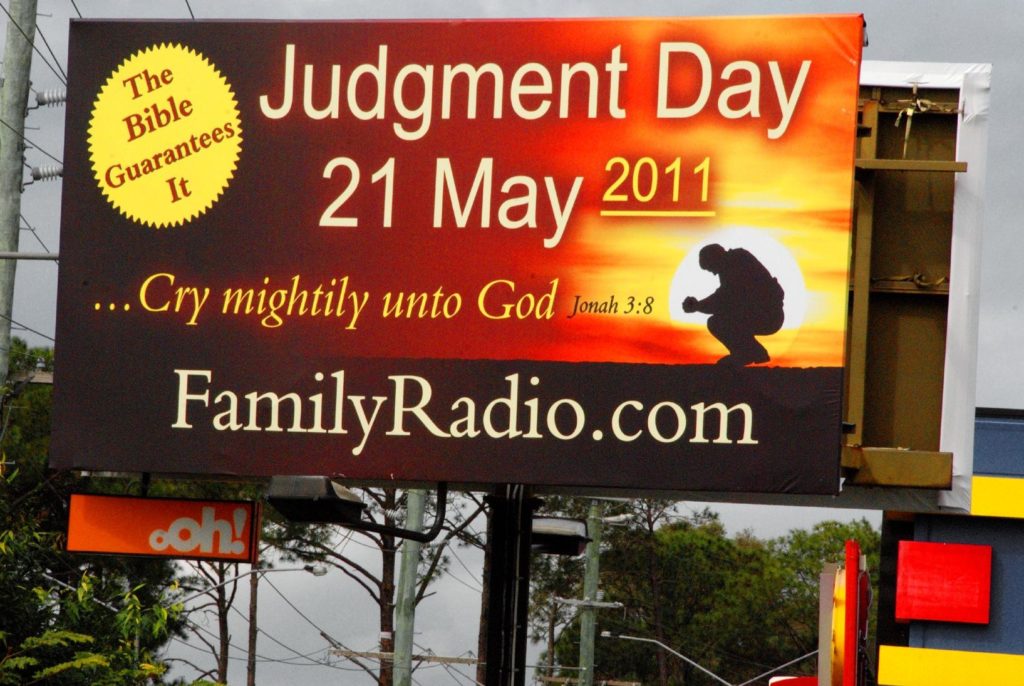
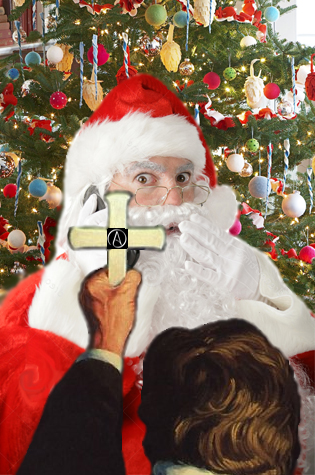
I will admit right up front that the Tim Tebow phenomenon is insignificant, but because it appears to be impossible to avoid if one watches the news (not even just the Sports segment!), I might get away with a brief comment on it here. As I understand it, this Tebow fellow drops to one knee and prays after any and every successful maneuver, right there on the gridiron, in full view of the stands. He wants to avoid claiming the glory for himself and giving the credit where it is due, to the Almighty, who, being omniscient, can scarcely be oblivious of what is happening in the game, or, for that matter, in every brothel, crack house, and Congress. Many applaud Tebow’s “courageous” stand for his faith; others complain that he is imposing his religious expression on the stadium and TV audiences who do not necessarily share it. What are they supposed to do, turn off the game? They shouldn’t have to. But what do you expect? This sort of piety masks its arrogance under the veil of humility: “You don’t like it? Tough: it’s my Christian duty to be obnoxious—take it up with God!” Yeah? Well, you can take your faith and…

I am not aware that anyone is urging that T-bone’s freedom of expression ought to be curtailed by the authorities. I certainly am not. I just think of Janet Jackson and that guy that looks like an unshaven Popeye (what’s his name again?) and I call his religious gesture a “piety malfunction.” Actually, my critique is a purely theological one.

What I am about to say is basically superfluous given the expert comment rendered on a recent Saturday Night Live skit (available on YouTube) in which, in answer to Tebow’s prayer in the locker room, Jesus himself shows up to ask the enthusiastic football player to tone it down a little. The Son of God congratulates the team on their latest victory but points out that he is doing most of the work! When Tebow invokes Jesus like a genie, Jesus answers, but wouldn’t it be a little better if the team won the games on their own strength? Read the Bible, sure, but how about studying the playbook, too? This is an apt theological critique, very much akin to an SNL skit from years ago in which Sally Field plays a pious housewife asking Jesus not to let the roast burn, etc., every five minutes. Phil Hartman appears as Jesus, asking her to save the prayers for the really important matters. It is scathing because it is not a parody (a distortion for laughs) but rather a true satire (accentuating the actual absurdity inherent in a thing). The same goes for the Tebow skit. Bravo!

But some viewers didn’t like it, a fact which will not exactly surprise you. Pat Robertson griped that, had such a skit been broadcast in Islamic countries, portraying the Prophet Muhammad instead of Jesus, the bombs would have been flying. I’m not quite sure what Robertson was implying with this comment: did he not-so-secretly want to issue a fatwa on the SNL cast?

What does surprise is that equal outrage came from a man one might deem Robertson’s opposite number: arch-liberal Bob Beckel, one of the hosts of the FOX News talk show The Five and one-time campaign manager for Walter Mondale. Beckel said it was “despicable to portray our Lord and Savior Jesus Christ” in such a manner. Bob Beckel? Bob Beckel, Obama ass-kisser? Self-proclaimed Socialist? Aren’t such people supposed to be secularists, even if they occasionally try to feign religiosity in order to gull believers (Howard Dean: “My favorite New Testament book is Job”)? Well you see, until recently, Bob was languishing in the grip of alcohol and drug addiction. He snapped out of it with the help of one-time Moral Majority bigwig and conservative columnist Cal Thomas, who “led him to Christ.” Sounds good to me; I think it is much more important for someone to get off drugs and booze than for one to come around to my views about religion. Whatever it takes! Nation of Islam? Scientology? Whatever gets you out of a living hell.

But perhaps ultra-liberal Beckel simultaneously being a religious fundamentalist is not so incongruous after all. He is refreshingly hilarious and not given to plaster sainthood. But one sense in which he is perfectly suited for his new creed is that he, as a political apparatchik, is a veteran spin doctor, ready to put a good face on a bad reality, making the outrageous seem plausible with a straight face. He could become another William Lane Craig if he wanted. Bad evidence is just waiting for Bob to redeem it. What he could do with intractable Bible contradictions! With the authenticity of the spurious Josephus passage! Of course, he could only convince those who already want to see things his way, but that’s the whole point. And he’s already a master at it.

I have to admit that, from a free thought, atheist point of view, I have one reaction to Tebow’s forthright faith and its conspicuous confession. Have you ever heard a friend boasting about something that hardly deserves it? A bad record album or an utterly undistinguished acquaintance? You suspect it is a variety of the inferiority complex and signals an inner shame or embarrassment they deep-down know they ought to feel. They are bluffing their way through it, hoping to bamboozle you into thinking there must be something to it after all. Cognitive dissonance reduction? Just saving face? They’d rather seem deluded than admit to themselves they’re magnifying nothing. I have to wonder if that is what is happening when Tebow and other in-your-face religious athletes publicly brag about faith. I cringe; I wince. I think it is sad they are just so proud of being so ignorant. I think of Philippians 3:19, “They glory in their shame.” Sort of a religious equivalent to Larry the Cable Guy.

But from a Christian standpoint, the reaction has got to be one of amazement. How can this Tebow be giving glory to Jesus when he is in the same moment disobeying him? For Jesus said (we are told), “Be careful not to practice your religion in front of others so as to be seen doing it… And when you pray, do not be like the hypocrites, because they just love to pray standing in the synagogues and the corners of the public streets so they may be on display… But when you pray, enter into your private room and, having shut your door, pray to your Father, he who is invisible“ (Matthew 6 1, 5, 6). Of course, one might counter that Tebow is not publicly praying with this motivation; rather, he feels it is important to make a testimony for Christ amid an irreligious culture. But is it? Is the stadium filled with members of the American Humanist Association and the Freedom from Religion Foundation? I doubt it. And besides, don’t you think anyone who prays in public and makes a big deal of it rationalizes it this way? How can pride not enter in? “What a good boy am I!” The whole logic of the passage is to “build a hedge around the Torah,” taking preventative measures lest a seemingly harmless act lead one into sin, in this case, self-righteous boasting.

And then there is the trivializing absurdity of bringing God down to the level of football while one stupidly thinks one is raising football up to God. There’s a time and place for everything, as when Dietrich Bonhoeffer quipped that one really ought not to be longing for heaven while in the arms of one’s spouse. Or remember when the Reverend Norman Vincent Peale, when a reporter asked whether Peale thought Jesus would have looked askance at his attendance at the Super Bowl, replied, “If Jesus were alive, he’d be here today.”

So says Zarathustra.

pjmedia.com~~~~~~~~~~~~~~~~~~~~~~~~~~~~~~~~~~~~~~~~~~~~~~~~~~~~~~~~~~~~

The Problem of the Parables


You may know that I have argued that exactly none of the gospel sayings “of Jesus” stem from a historical Jesus of Nazareth, and not for the simple reason that there was no historical Jesus. No, my reasoning on that score is inductive, not deductive. My initial working hypothesis was to assume there had been such a Jesus, an itinerate holy man active during the tenure of Pontius Pilate. Following in the seven-league footsteps of Rudolf Bultmann and Norman Perrin, I scrutinized the gospel sayings, alert for signs of anachronism, borrowing from other contemporary sources, tendential constructions by the early church, prophecies from the Risen One through the lips of charismatics and apostles, and anything else that might imply inauthenticity, that the material originated post-Jesus. But at length, I found so much of it to be fatally problematical on these criteria, that I wound up regarding the estimates of the oh-so-skeptical Jesus Seminar (18% of the sayings probably authentic to Jesus) as hopeless optimistic.

Now I find myself noticing gospel texts that come near to admitting the secondary character of a lot of the material. It starts with the parables, many of which were first collected as they appear in Mark 4. These include the parables of the Sower/Soils, the Lamp, the Seed Growing Secretly, and the Mustard Seed. Matthew revises and expands the section, as we read it in Matthew 13. The new Matthean parables look to me to come from Matthew’s own hand rather than from some pre-existing “M source,” and the same is true of the uniquely Lukan parables (Lost Coin, Lost Sheep, Prodigal Son, Good Samaritan, Dishonest Steward, Pharisee and Publican, Unjust Judge, etc), which all share similar narrative features; in other words, no “L source.”

But back to Mark. Mark 4:33-34 says, “And in many such parables he spoke the word to them, as much as they were able to grasp. And unless he had a parable he did not speak to them, but in private to his own disciples he explained everything.” It suddenly occurs to me that this statement implies that whoever said it did not know of other, non-parabolic teaching of Jesus, which nonetheless abound elsewhere in this gospel and all others: aphorisms, apocalyptic sayings, straightforward admonitions, etc. The impact of this incongruous statement is comparable to the astonishing statement in Mark 8:11-12: “The Pharisees came and began to argue with him, seeking from him a sign from heaven, to test him. And he sighed deeply in his spirit and said, ‘Why does this generation seek a sign? Truly I say to you, no sign shall be given to this generation.’” Mustn’t that verse stem from a time when people believed the incarnation was so complete that Jesus had left all divine powers behind in heaven (cf. Philippians 2:6-11)? First Corinthians 1:22 likewise says that “Jews seek signs [precisely as in Mark 8:12]… but we preach Christ crucified,” which certainly implies Paul knew of no miracles ascribed to Jesus, which is why his letters never mention a single one.

My point is that Mark 4:33-34 makes the same sort of programmatic statement: there were no non-parabolic teachings circulating in the writer’s day. Sure, we find non-parabolic material elsewhere in Mark, but the same is true about the miracles: Mark has plenty, even though he has preserved a saying that rules them out, justifying the absence of miracle stories in the time that saying originated. And this all in turn implies that the non-parabolic teaching was a subsequent addition, aimed at filling the perceived gap—just like the miracle stories.

But it occurred to me also that one must look again at the parables and ask if it is really plausible that people came in droves to listen to this stuff. The narrator himself tells us what the history of parable interpretation makes abundantly clear: there is no clear point to any of these parables. No one could have taken away enough meaning to keep him coming back for more. They are not like Aesop’s Fables. Commentaries on Mark and tomes on the parables (and there are very many of both) offer endless possible interpretations of the parables, all of which make the parables’ meaning dependent upon some larger theological system extrapolated from the gospel as a whole, or from a life of Jesus construct as a whole. Such a framework for interpretation is a chain of weak links.

And the recent readings of the parables by Dan O. Via, Bernard Brandon Scott, and Charles W. Hedrick strike me as so over-subtle and counter-intuitive that only fellow specialists playing the same exegetical game could possibly find their interpretations even plausible much less convincing. In short, I can imagine Jesus getting and keeping an audience with this lame material as easily as I can imagine anyone memorizing the whole of the Sermon on the Mount from hearing it once. Just take your head out of the text, and out of the scholarly game, and you’ll agree with me.

So Jesus taught only in parables, which disallows everything else. But then he could not have taught with these parables either. It all reinforces the conclusion that there was originally no such figure as “Jesus the teacher” or Rabbi Jesus. Maybe this is why the Pauline epistles never appeal to any sayings ascribed to Jesus either. There weren’t any yet. That would come later, and not from Jesus.

And remember Mark 13:11? “And when they lead you before the authorities, do not bother formulating beforehand what you will say, but whatever comes to you on the spot, say it. For you are not the speakers, but the Holy Spirit.” I draw the same inference from it that Luke did in his rewrite: “I will give you a mouth and wisdom that none of your adversaries will be able to withstand or refute” (Luke 21:15; cf John 16:12-15: “I have many more things to tell you, but they would be too much for you to deal with now. But when that one comes, the Spirit of Truth, he will guide you into all the rest of the truth. For he will not speak his own opinions, but he will relay what he hears, and he will announce future events to you. He will glorify me, because he will receive revelation from my treasury and announce it to you..”). In the heat of argument, don’t worry: Jesus will supply the words—which then must have been simply ascribed to him, with no concern whether they were spoken by an earthly, historical Jesus, or by a post-Jesus Christian prophet/confessor. Wouldn’t this be the ideal candidate for the origin of all those controversy stories in which “Jesus” reduces his opponents to silence with his clever retorts?

Nor let us forget Matthew 10:27 (a saying from the Q source, shared with Luke 12:23, where, however, it is made to have a very different point), “What I tell you in the dark, utter in the light, and what you hear whispered, proclaim upon the housetops.” Remember how the gospels sometimes rationalize the late appearance (thus secondary character) of certain stories like the Transfiguration and the Empty Tomb by claiming that the Jesus-era hearers either were warned to delay reporting it (Mark 9:9-10) or just failed to report it (Mark 18:8). That’s why you’re hearing about it only now—yeah, that’s the ticket! Doesn’t it make sense that Matthew 10:27 should denote the same thing? That those who later credited their own preachments to Jesus in order to give them added clout “explained” why no one had heard them before by claiming they had first been told in secret? That is a classic Gnostic ploy, to maintain that Jesus had taught their newfangled teachings to the apostles all right, but in secret, which is why riff-raff like you never heard of them till now! Again, this, I think, is a signal within the gospels that their material is spurious.

Another comes in Luke’s version of a Q saying. Where Matthew had “Whoever welcomes you welcomes me” (Matthew 10:40), Luke (10:16) has added “Whoever hears you hears me.” This might easily mean the same thing, but one must wonder whether Luke’s version was understood (and was intended) as a license to speak (fabricate) new words of the ascended Jesus.

So says Zarathustra

(who knows a thing or two about parables)


Dec 4 2011

Thanksgiving and Theonomy

Q

I’ll warn you up front. The theme I’m going to be expounding is really pretty simple, so obvious and transparent that the kind of explanation I propose giving you will only serve to cloud and burden the issue. But I can’t resist seeing how the phenomenon invites “explanation” in needlessly abstract, theoretical terms! Bear with me. Or not. I may be an atheist (my Catholic mother-in-law says I’m not), but I’m still a theologian. So obfuscation, you might say, is my job.

A couple of days ago, on Thanksgiving, I read a post on our Bible Geek Facebook discussion page where some of the geeks were relating what the holiday meant to them. You see, many of The Bible Geek listeners are irreligious atheists. Yet they don’t necessarily want to annoy others by making themselves conspicuous in their refusal to observe Thanksgiving—no One to thank, after all. What to do on that day? Can they munch turkey with a clear conscience? Or would that be atheist hyper-scrupulosity, the very kind with which we are familiar from fundamentalist legalism?

I also learned of the President (I guess I am thankful for his exterminating Osama bin Laden) neglecting to mention God in his yearly Thanksgiving radio address. A commentator proceeded to pontificate on the “real,” “proper” meaning of Thanksgiving. Obama described it as a time for appreciating good things, like the courageous service of our troops. A time for community sharing and solidarity. You bet! But Obama didn’t mention God. Perhaps the President is, as Eddie Tabash says, essentially a secularist. Or maybe he cared more about not “offending” the secularist minority (e.g., my pals at Freedom from Religion Foundation) than about the religious majority of his subjects (as he seems to perceive them). It is the kind of crazy thinking that will eventually lead to the banning of religious affirmation as hate speech. (On the other hand, certain big-mouth Muslims might give some credibility to that!).

Anyway, the commentator did not seem aware of the fact that the meaning of words and customs evolves. Like Christmas, it may simply be that Thanksgiving has grown to denote the things the President highlighted, even more than literal gratitude to a Providential Creator. One of the Bible Geek listeners said he was “grateful” for the good things in his life and felt nothing particularly theistic about being ”thankful” for them. And why not? I would argue that Christmas, too, has become predominantly secular even for most Christians, though no less wholesome for that, a celebration of family, childhood, and giving. Why not? What’s the problem with that? I remember hearing a fundamentalist years ago quipping, “For the Christian, Easter is where the action is, anyway.” The New Testament would certainly back her up on that.

Pedantic weirdo that I am, I could not help noticing how the issue of a secular Thanksgiving is a good instance of something Friedrich Schleiermacher and Paul Tillich (my favorite theologians along with Thomas J.J. Altizer and Don Cupitt!) discussed. In Schleiermacher’s terms, a secular Thanksgiving would be an example of the feeling of dependence but not of Absolute Dependence, the latter being the key element of religious consciousness. You see, Schleiermacher (my beloved Professor Robert F. Streetman, AKA the Swami Streetmananda, used to pronounce it with his unrepentant Mississippi accent, as “Sligh-uh-mok-uh”) explained how we are all relatively dependent on all others in our world because we are interdependent. My safety depends on drivers not being drunk, on contractors not using flimsy materials, druggists not making mistakes like Mr. Gower’s or employees like young George Bailey failing to catch those mistakes. We ought to recognize this fact. But to be religious, we need to recognize an absolute dependence upon the divine and infinite totality of Being, which is traditionally called “God.” (Schlieiermacher was heavily influenced by Spinoza, dontcha know.) Well, our atheists and secularists who chew up turkeys and are thankful for the chance to do so are relatively but not absolutely dependent and acknowledge it. President Obama was showing his relative dependency on the people of his excellent country. But with no larger frame of reference, there was by definition no religious element.

Tillich, borrowing some terms from Kant, spoke of a dialectic between theonomy, heteronomy, and autonomy. He says that “religion is the substance of culture,” while “culture is the form of religion.” It is a philosophical approach to the same insight sociologist Peter L. Berger describes as the Sacred Canopy of values, myths, and meanings that constitutes traditional cultures. Everything has its place and derives its meaning from the Great Chain of Being, to switch metaphors again. Cultures like ours, in their modernism and pluralism, lose that integrating, defining center and have to come up with an artificial substitute (like Civil Religion or patriotism), sort of like that moon of Jupiter that anciently exploded but then imploded again to form a new sphere made of the same bits and pieces. Well, Tillich speaks of historical periods in which the culture was “transparent to its divine Ground.” No tension was felt between the religious worldview and everyday life or even intellectual pursuits. Laws were to be obeyed because God or the gods have given them. One pursued scientific research because nature was the good creation of God. And so on. This condition can be called Theonomy (which has nothing to do with the use of the same word by the Christian Reconstructionist movement), or “divine law.” Divine law is the inner law of one’s own being, so there is harmony with it unless one be alienated from oneself.

But cracks begin to form. Scientists discover things about the world and about human nature that do not square with religious dogma, The Church cracks down and prosecutes “heresy.” It censors scientific achievements and artistic creations, bans books with philosophies that ignore the theological party line. In this case religion has made an idol, a false god, of itself. Theonomy has soured and turned into heteronomy (an “alien law”), a counterintuitive law that must be imposed from without, outside of the individual’s conscience and better judgment. Free souls and free thinkers have no choice but to reject heteronomous religious authority and to trust their own admittedly fallible judgments, Of course this is what happened in the Enlightenment, the Renaissance, and the French Revolution. The resulting condition is autonomy, steering one’s course by one’s own law. One’s essence is still in harmony with its divine Ground so long as one searches for Truth, Beauty, the Good, which can never be other than Divine. But the autonomous thinker naturally does not see this, given the social and institutional options open to him. The autonomous person for the moment accepts the Church’s claims to have a copyright on religion and therefore rejects religion along with the tyranny exercised in its name by those who made it into an idol. This, it seems to me, is where we find our militant secularists and atheists.

Tillich would say such autonomous souls are still grasped by the ultimate concern. A real and genuine “secularist” or “atheist” would be, he says, someone who sees no depth in life, who has nothing to live for. One addicted to superficialities. And that’s no atheists I know. This means atheists/secularists are still grounded in the divine Depth, in the Ultimate, though they have for the time being had to repress knowledge of the fact, given the Church’s arrogation of the “religious” label for itself. You can see exactly what I’m talking about in the virtually superstitious fears some secularists have toward myth and symbol. They know these things only from religion and religion’s heteronomous use of them, so they recoil in terror when they come across them. I recall a friend of mine, an ardent Secular Humanist, who was fully as wary of the Harry Potter books as any fundamentalist, and for the same reason: the books depict magic as a reality, and children must be protected from that! Yet that same Humanist was a great fan of Star Trek. The imaginative realm is fine, then, as long as there is no fantasy about the supernatural! That’s autonomy so afraid of heteronomy that it shuns theonomy, too, having forgotten the difference.

In a secular celebration of Thanksgiving, I see autonomy beginning to reopen itself to the “divine” grounding of its underlying depth, theonomy. Those who stubbornly refuse to eat the sacramental turkey and instead poke fun at the day by observing Norm Allen’s anti-holiday “Blamegiving” are still on the far end of the pendulum swing.

If we understand this, we can see why Tillich seems to be co-opting idealistic, dedicated atheists as “religious” despite themselves (sort of like Karl Rahner’s “anonymous Christians”). It is not a sneaky tactic of some kind, like registering Mickey Mouse or dead people as voters. It is a way of understanding the irreligious sympathetically in religious terms instead of considering them enemies. Come to think of it, maybe this is what my mother-in-law Cecilia has in mind when she says I’m not really an atheist. Maybe you aren’t either.

So says Zarathustra.


Nov 6 2011

Costumed in Confusion

Q

It’s time to defend Halloween again. It’s coming up very soon as I write, but it will be just past when you read this. The other day, Carol and I noticed two Halloween-related items. First, the local newspaper carried a story about–get this—a Halloween egg hunt. Huh? I’ve heard of combining Christmas and Hanukah into “Christmukah,” which makes little sense to me, mainly because it would appear to obscure the meanings of both holidays that have been crammed into the blender. Well, here we go again! Easter eggs for Halloween? Is the goal to assimilate Halloween, mistakenly imagined as a pagan holiday, to Easter? I could see it, I guess, if the point was to assimilate the resurrection to a zombie or vampire story, but I doubt anyone has thought it through to that extent.

I had noticed a day or so earlier how some school or church was advertising a “Harvest Festival.” True, this is a farming community, so such a celebration would be entirely appropriate. But I cannot help suspecting that “harvest festival” is just a sanitized, emasculated substitute for Halloween, just like the Secular Humanist attempts to celebrate Christmas while denying they are doing it by renaming it “Solstice” or “Humanlight.” Ho ho ho.

There is a particular irony in shrinking away from Halloween in superstitious fear and retreating to a Harvest Festival or Fall Festival, because such a celebration of seasonal passage is essentially pagan, a vestige of nature worship. By contrast, Halloween (which means “Eve of All Saints Day”) is a Christian holiday, mocking the powers of Evil in light of the victory of Christ. But if that’s too theological for you (and I admit, it is for me these days), how about this? Halloween is an occasion to laugh at our fears (especially fear of death), which is to defy death and thus to triumph over it in the only way poor mortals can.

And that leads me to the second thing Carol and I noticed. We were watching a new episode of The Office, and the theme was a Halloween party, organized by the office staff. The new CEO, Robert California, a bit of a Zen master, complains that the costumes and decorations, the general mood, are just not scary enough. He takes one look at the “costume” sported by new manager Andy Bernard, who is dressed as a utility worker of some kind, complete with flannel shirt, jeans, and a flashlight helmet. The boss says to him, “So on this night of wild fantasy, you’ve dressed as a laborer.” Is Andy signaling that work is a horror to him?

Kevin, Darryl, and Jim are wearing Hockey (or some sport) jerseys. Angela is a cat, Pam a rabbit. Kelly, Toby, and Gabe are wearing cutesy skeleton costumes. Stanley is a chef. Only Dwight is really up for it, decked out as a monster queen from a video game. Creed is garbed as Osama bin Laden. Erin is made up as the hamburger mascot Wendy. Robert California (not costumed) goes around unobtrusively asking most of them what they personally fear the most. At the end of the evening, he tells the gang an impromptu scare story he has woven together from their individual fears. They seem more sobered than entertained. But the boss sees that this is the whole point: facing your fears. Not fleeing them. Not pretending there is nothing to fear (perhaps in the vain hope that religion can protect you from them). But facing them as fears, even if our Halloween celebration is to some extent whistling in the dark. What’s wrong with that? At least it’s not self-deception.

Tillich somewhere says that the more Nonbeing that Being can take into itself, the stronger it will be. The fantasy evils and monsters of Halloween serve to incarnate the Nonbeing of our fears. By embracing them in a spirit of shivery fun, we take the Nonbeing into our own being and become stronger for it. I think that, without that jargon, the basic lesson is conveyed even to children, or at least it would be if we still really celebrated Halloween.

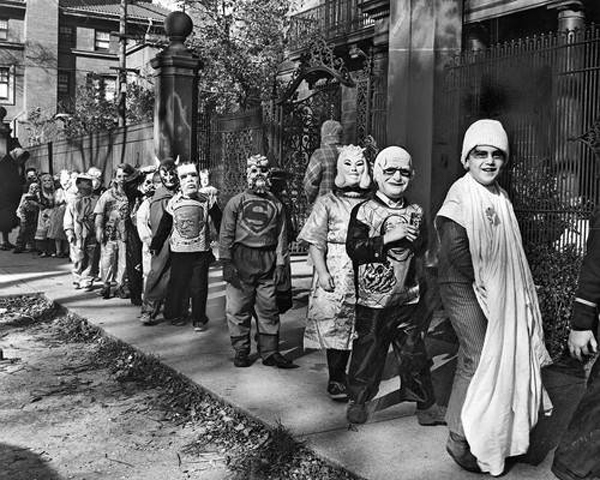
The demise of Trick or Treat attests this cultural failure of nerve. Back in the early 1970s baseless urban legends of candies containing razor blades frightened foolish parents into keeping their little darlings home and off the streets. Didn’t they realize they were implicitly casting the pall of suspicion on their neighbors, whom they signaled they believed might be molesters and child-murderers?  So kids went instead to Halloween parties in private homes, churches, or schools. That would not have been a fatal blow (major though it was). The real damage to the holiday was the trend toward sickeningly innocuous costumes. Rainbow Bright? Clowns? Bums? Sponge Bob? Princesses? Dogs?

What the hell?

This is Halloween, for Boris’s sake, not some “come as a weakling” costume party! Where are the Werewolf, Frankenstein, witch, mummy, vampire, and devil suits? They have succumbed to the real horrors: the friggin’ Care Bears and Barney the Simpering Dinosaur (no wonder they went extinct!). “Harvest Festivals” denote a shallow sense of life, a self-deceiving pretense that there is nothing to fear, so that courage never even comes up as a virtue.

People seem to think that fear is the thing to fear. But it is not. What is courage after all, but the determination to act, to do one’s duty, despite one’s fears? To act without fear is mere rashness, foolhardiness. I think of a 1990S Justice League comic written by Grant Morrison. In it, Daniel the Sand Man, a master of dreams and the subconscious, reassures Kyle Raynor, the new Green Lantern, as he is about to go into battle, unsure of his abilities to fill the shoes of his illustrious predecessor Hal Jordan. The Sandman says, “You will surpass him. You already know what he could never learn.” Kyle asks, “What’s that?” The answer: “Fear.”

So says Zarathustra.

Seventh Seal ref


Oct 9 2011

Is Mitt Romney a Cultist?

Q

The other day, the pastor of First Baptist Church of Dallas, not exactly a bastion of intellectualism or fairness, lambasted Republican presidential candidate Mitt Romney as being a member of a “cult” and not a Christian at all. One might dismiss the whole thing as a case of the pot calling the kettle African American (that is the Politically Correct idiom, no?), given that the pastor is a Southern Baptist. I think Mike Huckabee (also a Southern Baptist) had it right when he said Americans must be tolerant above all else, and that Romney’s denominational tag is immaterial for political purposes. Indeed, the fact that his Dallas colleague sought to disqualify Romney for public office on account of his “heretical” creed is itself pretty “cultic.” But the pastor’s concern is an interesting one and raises a couple of important issues and opportunities for clarification, which I intend to exploit here. Hope you don’t mind.

First, what is a “cult”? The term is commonly hurled at religions that most people don’t like, minority religions which one feels it is possible to get away with offending publicly. But there is a “proper” use of the term, that is, a technical denotation. Two of them in fact, and they sometimes overlap. First, a cult is a religion transplanted from one culture into another, e.g., by way of missionary efforts, planting the religion’s flag in new territory. It appears, at least initially, odd to its new neighbors who are unfamiliar with its tenets and are roused to suspicion by the simple fact of novelty. :”Whatsamatta? Ain’t the old time religion good enough for ya?” Eventually the new religion becomes more familiar, even if most folks don’t agree with it, and the members seem less threatening. The ancient Mystery Religions with their dying and rising gods and their secret initiations were originally at home in their Eastern agricultural settings. When many members relocated in the West through commerce, being taken as slaves, or whatever, they congregated in new urban surroundings and became Mystery Cults, since they were new and strange-seeming. Sometimes such exotic “cults” were attractive to many outsiders, like the Isis and Osiris religion and Judaism.

The cultural and ethnic foreignness makes such a new, transplanted faith seem suspicious to many, as was the case, I am sure, with the Unification Church of Korean Reverend Sun Myung Moon and the Hindu sect the International Society for Krishna Consciousness, a venerable and familiar faith in its native India, dating back to the 14th century.  Yellow Peril and all that nonsense. People took one look at Reverend Moon and thought “Fu Manchu” or “Ming the Merciless.” Mormonism was not foreign in origin, but it was new and different, and it did suddenly pop up in various American communities, so the effect was much the same. So it is not too far-fetched to call Mormonism (the Church of Jesus Christ of Latter-day Saints) a “cult” in this sociological sense. But by now, how can it seem subversive to outsiders, most of whom hear “Mormon” and think of the Mormon Tabernacle Choir? If you have any Mormon acquaintances, you know them to be nice people of good character and the staunchest imaginable upholders of traditional values. Even at that, there is a healthy range of opinions among their ranks, as witness the liberal Harry Reid.

I know what you are thinking: “Traditional values? These people are polygamists!” I hate to tell you what you already know, but even this is a traditional value, certainly older than the monogamous nuclear family. Just look at the Hebrew patriarchs Abraham, Jacob, and others. Polygyny (a husband with multiple wives) persisted into Jesus’ era and survives today among Muslims, of whom there are over a billion. Like arranged marriages, polygamy is one of those practices, one of those values, we have jettisoned in favor of newer models. So you may not fancy polygamy, but it is certainly not some wacky innovation like, say, dating, romantic love (a modern Western invention and, of course, a good one) or Gay marriage.

And the major Mormon denomination officially frowns on polygamy anyway, though it remains widely practiced in Utah, where the police pretty much ignore it, being too busy out catching crooks.

There is, as I anticipated, a second denotation of “cult.” A cult may refer to a religion, usually necessarily a small one, in which a charismatic leader controls the lives of individual followers, perhaps dictating marriage partners (even dissolving marriages and reshuffling spouses) and career choices. Such a cult leader may maintain a surveillance system among members. His word goes. Reverend Moon chooses who will marry whom in the notorious mass weddings. Often the spouses have never even met one another before they are matched by the Lord of the Second Advent in his Spirit-inspired wisdom. The sinister Jim Jones made life hell for many in the People’s Temple, meting out cruel and unusual punishments for perceived disobedience. Does Mormonism feature anything like this? Jailed prophet Warren Jeffs sure did, but remember, he was the head of an outlaw sect, the Fundamentalist Church of Jesus Christ of Latter-day Saints.

Was the original LDS prophet Joseph Smith a cult leader in this sense? I should think believing, ground-floor Mormons were pretty eager to obey his every behest, as many of us would if we were in the same situation (not that we should). But the larger a faith community grows, the quicker such a stage will be left behind. There will be too many Indians and not enough chiefs to keep an eye on them. The prophetic decrees of the founder will have been laundered and whittled down, the weird and arbitrary elements, anything unworkable, quietly trimmed away. Thus, as Max Weber said, charisma is routinized, and charismatic authority (with its arbitrariness) yields to legal authority (with its regularities). So I think Mitt Romney’s religion is no longer a cult.

But is it a heresy? Is it no longer Christian? It is not Trinitarian. It adds the Book of Mormon (strictly irrelevant to LDS beliefs), the Book of Abraham, Doctrines and Covenants, and The Pearl of Great Price into its scriptural canon. They believe the angel Moroni appeared to Joseph Smith and charged him with restoring genuine apostolic Christianity (just like many other sect founders) and sent him to dig up the Golden Plates of the Book of Mormon which recounted an ancient voyage of Judeans to American shores, eventually giving rise to the Indian tribes. These are not exactly standard brand Christian tenets. These beliefs mark Mormons off from mainstream Christians, who may debate over infant versus convert baptism but who do not practice baptism for the dead (as the Mormons do, based on 1 Corinthians 15:29, and as the ancient Marcionites and Cerinthians did).

The question is: how do we define Christianity? Who has the copyright on the term? Who is entitled to draw up the ruler against which would-be Christianities are measured, qualified or disqualified? I reject that approach as utterly unhelpful. I want to draw distinctions, too, so we can clarify things. But there is a better way to do it. We can construct a basic “ideal type” or textbook definition of “Christianity.” It will not cover every detail or department. Some supposed Christianities will fit the paradigm better, more closely, than others. That is okay, for the goal is not to see which faiths can be neatly stuffed into the box labeled “Christianity.” Rather, the idea is to provide coordinates along which each type of ostensible “Christianity” can be measured, and this is merely descriptive, implying no value judgments.

Let’s take one particular coordinate. It would be reasonable to posit that any form of Christianity would be Christocentric. Jesus Christ would be the central figure, the mediator between God and the human race. Jesus is quite important in Islam but by no means central. That place of honor belongs instead to the Prophet Muhammad, who has superceded him, just as in the Baha’i Faith Muhammad has been superceded by Baha’ullah. This is why we do not consider Islam part of, a type of, Christianity (or the Baha’i Faith part of Islam). What about Lutheranism or Wesleyanism? The respective founders are very important as interpreters of Christian faith, even as normative ones, but they are not central. They do not threaten the centrality of Jesus Christ. A wonderful old story recounts how a devout old lady interrupted a polemical sermon taking sides in the raging debate between Calvinism and Arminianism. She urged the preacher to forget about John Calvin and Jacob Arminius and to get back to Jesus Christ! Such a rebuke made sense because neither Calvin nor Arminius are supposed to have nearly the same importance as Jesus Christ does in either system. If Jesus has been pushed out of the spot light, something is wrong because Christianity of any stripe is by definition Christocentric.

But the same is not true in the Unification Church. No one would say, “Enough already about Sun Myung Moon! Stick to Jesus!” In Unificationism it is understood that Reverend Moon occupies the prophesied role of the Lord of the Second Advent, he who is destined to bring the work Jesus began to final fruition. Thus Jesus is no longer quite central. No mere appendage or predecessor, not a forerunner like John the Baptist was to Jesus, and surely a tough act to follow. But his successor is taking the stage. The ellipse has two foci, and the focus is shifting to Reverend Moon.

I should say the same thing has happened in the case of Mormonism, where Joseph Smith is more important than Luther for Lutherans, Wesley for Wesleyans. But Joseph Smith is not so important as Jesus. After all, the movement is called “the Church of Jesus Christ of Latter-day Saints,” not “the Church of Joseph Smith.” But the focus has shifted a bit, maybe more than a bit.

In short, in a merely descriptive sense we could say that both Unificationism and Mormonism fall farther from the Christocentrism coordinate than Lutheranism, Calvinism, etc., but not quite so far as Islam does. Mormonism may be on its way to becoming a separate religion, though it has not arrived there yet and may never do so. Is this way of charting it out messy and inconclusive? Why, yes, but that’s the only accurate way to view the matter. Reality is messier than the categories we rightly use to analyze it. A ruler is for measuring. It is not the same thing as a carpenter’s straightedge which you use to cut away whatever does not neatly conform to pattern.

So is Mitt Romney not a Christian? Is Harry Reid? Is John Huntsman? Is Glenn Beck? Was Brigham Young? It is hard to answer that question precisely because it demands a degree of clarity that does not exist. It demands that the factual phenomena fit squarely into boxes, but that is not what religious tags refer to. They are ideal types, coordinates by which to measure and tools to understand the uniqueness of every particular item we examine. The question is not “Is a Mormon a Christian?” but rather “What is a Mormon?”

And if both Reid and Romney can be Mormons, I cannot see why anyone should worry about Mormonism dictating an office-holder’s politics in any particular direction.

So says Zarathustra.


Sep 9 2011

The Roaming Noam

Q

noam chomsky

I just watched the Noam Chomsky documentary Manufacturing Consent and enjoyed it very much. Chomsky comes across as unassuming and humble, a man enduring what he has to both in labor and in reprisals, for pursuing the course he believes destiny has assigned him. Very likeable. And admirable.

Yet I can’t help thinking he is seeing a conspiracy where none exists. He is an anarcho-syndicalist and therefore despises any form of government (and all give plenty of reasons to do so!), and this is inevitably going to mean he is going to barrage them with criticism no matter what they do, for existing at all. He aims his thunderbolts from an empty heaven of pure theory that is never sullied by no-win situations and lesser evils. He does not propose an alternative type of government, but merely wishes there were a vacuum, and he would try to prevent human nature from filling it, as it did in the beginning and would do again. It is not a conspiracy for there to be government, though a relatively small number of people are in charge. That is theoretically no more than specialization, though in fact an oligarchy/plutocracy may develop (I think of Leonid Brezhvev, man of the people, with his collection of luxury cars). But somebody would rule, and we would want somebody to, to protect us. Even if the best candidate were Tony Soprano.

I found it remarkable that Chomsky admitted both that this is the freest society in the world and that it had been necessary to sacrifice that freedom temporarily to survive during WW2. Doesn’t that tell him anything? Like maybe that government isn’t necessarily so bad? And that occasional control over human behavior (which is what any government is, after all) isn’t necessary only when Hitler looms?

I loved what Chomsky said about the Superbowl and other popular idiotic entertainments, how they are mere distractions to give the cows some cud to chew on instead of thinking about anything important. And yet I think Dostoyevsky rings truer: people want such bread and circuses, because they shun the burden of real thought, responsibility, and decision. There is not some secret cabal that keeps them hypnotized. No such thing is necessary (alas!).

I’ve read enough of the Utne Reader to know that certain news stories are never allowed coverage, but it is not necessarily a result of corporate interest. When it is, it may be an exception, as when everyone knew CBS killed a story on Big Tobacco because they wouldn’t be able to afford the lawsuit they were threatened with. People despised and derided CBS for this. Which implies it doesn’t happen all the time as a matter of policy. My guess is rather that the choice of news has more to do with the Family Feud model–what do the average viewers want to hear about? Surely that is the reason there is time wasted with sports “news” daily. In other words, I suspect a lot of what Chomsky attacks comes from the ground up, from the grassroots, not from the top down. And that is far more depressing.

Conspiracy theories are the most optimistic theories around! They centralize and simplify our problems. They are demythologized versions of the Christian belief in Satan. Stop me if you’ve heard this one before, but shortly after the 1978 Jonestown suicide I was talking with a professor at Gordon Conwell Theological Seminary, and he asked me (rhetorically) if I didn’t think these events were not a compelling demonstration of Satan’s power. I replied that I didn’t think so at all. Instead I took the whole terrible business as more evidence of the awful capabilities of human nature. If you think you need a devil to account for the Holocaust, you are a cock-eyed optimist! “Everything would be fine if we could just get rid of that horned, hoofed terrorist!” Don’t kid yourself. The problem is much more complex than that, and so is any possible solution. Same thing with secular conspiracy theories. They are imaginative schemes to find a scapegoat with a single face. They tend to absolve us of collective guilt and the complicity of our institutions as a whole. If you blame the Ku Klux Klan for our race problems, you are avoiding the much, much larger problems of institutional racism. (Not that the KKK deserves any mercy or even patience!)

You might wonder what Noam Chomsky thinks about 9/11. Surprisingly, he does not believe there is anything to the conspiracy theories. But this turns out to be the exception that proves the rule, since he suspects the Bush administration purposely fueled such conspiracy theories in order to distract the public from other nefarious actions the administration was performing! Nevertheless, the “Truther” movement seems Chomsky-esque to me. And it reveals the peculiar perversity of hate-America conspiracy theories. This is one of those rare instances where we do have an actual sinister conspiracy: Al Qaida—and it isn’t good enough for paranoids like theologian David Griffin. No, the World Trade Center demolition had to be the work of an even more sinister conspiracy, one worthy of an espionage novel: our own government took down the towers and killed 3, 000 of its own citizens, and this for no particular reason. (There were certainly better excuses, true or false, to attack Iraq.)

I was interested to hear from Chomsky, in answer to a simple question, that he gets his information about what is really going on in the world, not from the sold-out propaganda mills of the American news media, but rather from newspapers in other countries—which, presumably, are as objective as the day is long. Somehow, though working within societies that are anything but free, whose newspapers are not just de facto but de jure propaganda arms of the controlling juntas, these papers and broadcasts tell the unvarnished truth.

It reminds me of the college freshman who learns just enough anthropology to become convinced of Cultural Relativism, which he construes to mean: everybody is right except for the United States. “My country, wrong or wrong.”

Don’t get me wrong: I am far from trying to pretend everything is right with America, especially with her government and her policies. Far from it! I am by now pretty cynical. But nobody (e.g., Ron Paul, Pat Buchanan) is going to get me to believe that theocratic, nuke-toting Iran is harmless and that America ought to be spelled with a “k.”

So says Zarathustra.

myth conspiracy scapegoat


Jul 30 2011

No Truth but this One?

Q

It is not uncommon to hear us Nietzscheans and Deconstructivists raving that “There is no truth!” And it is just as common to hear someone retort, “But that’s the truth, right?” It is very much like the rejoinder to the similar affirmation, “’God is dead,’ said Nietzsche,” namely, “’Nietzsche is dead,’ says God.” And, I think, it is about as cogent, which is to say, not very. Am I contradicting myself when I say (it is true that) there is no truth? Is it methodological madness to say that we can never arrive at the truth? And am I therefore stuck saying that any old reading of the data (whether of scientific research results or literary texts) is as good as any other? I don’t think any of these dire results follow. Let me try to get clearer on my position on truth.

I invite you to go back in history to the ancient philosophical sect of the Skeptics, founded by Pyrrho. Pyrrho, like his latter-day counterpart Tomas Henry Huxley (who coined the term “agnostic”), pointedly did not dogmatically deny the possibility of certain knowledge. He merely averred that he did not find it available. Skeptics ventured that certainty did not appear obtainable because the old philosophical debates still raged. If any side to any debate (on God, free will, the good, etc.) had definitive proof or knock-down arguments to mount, the debates would have been resolved long ago. It is not hard to see the relative force and the reasonable character of arguments on both sides of many issues, e.g., abortion and euthanasia. The Skeptics concluded, tentatively, mind you, that certainty, real knowledge therefore did not seem available to poor mortals. If somehow some genius one day did discover some new evidence or some definitive argument, well, good! It would be good to know. But in the meantime, it seems like probability is generally a good enough guide for everyday life in this world. Isn’t it? We have to make tentative judgments under a deadline. In daily life, we usually do not have the option of sitting on the fence forever, as we do regarding unverifiable matters. So why worry about the supposedly ultimate questions which seem beyond our reach?

So, according to Skepticism, the truth seems so far to be unobtainable, though it may indeed exist. But if it does, it appears to be moot. If we cannot seem to access it, and that is all the assertion the Skeptic is making, what good is it? If there is an objective Truth “out there,” there might as well not be and to all intents and purposes there isn’t—if we can’t know it. And so far it appears we can’t. Objective, “capital T” Truth would seem to be like the tree falling in the forest with no ears to hear it. This is what I think the Nietzschean “death of Truth” proclamation amounts to. It is not a statement about Truth, a pretense of knowing it, knowing about it that it does not exist. That would be absurd. But the assertion is not directed to this hypothetical Truth that might or might not exist. It is rather directed back toward us as would-be knowers. It is a phenomenological account of epistemology. Inductive, not deductive.

Some are distressed by the broader implications of this skepticism for science, history, and literary interpretation. Is there no true reading, no definitive knowledge? Must we remain humbly satisfied with “merely” tentative and provisional conclusions”? It may frustrate some not to be able to dogmatize. They may fear a relativistic alternative, like that espoused by subjectivistic charlatans like the insufferable Deepak Chopra. But they needn’t be. This sort of skepticism, what Tillich called “methodological doubt,” grows out of simple experience. Look at the history of scientific “discovery,” of literary interpretation, of historical revisionism. In all cases we see a regular, if tumultuous replacement of accepted paradigms by initially controversial new ones. More and more become convinced that the new paradigm makes better, more naturally inductive, simpler sense of the data, especially of data “anomalous” in terms of the old paradigm. Usually new paradigms encompass most of the old ones, expanding their scope and explanatory power, but knocking down false boundaries and solving longstanding puzzles. Since we have managed to get closer and closer, wouldn’t it be premature to declare that we have finally arrived? Try out the latest paradigm and see if it helps. Maybe it will one day work it out of a job. As a skeptic’s bumper sticker says,”What if you’re wrong?” After all, you have been sure of this and that before, only to admit later on that you had been ignorant of this, had failed to take that into account. Think of “Truth” as like the North Star: you navigate by it, but you don’t expect to get to it!

It is like the Via Negativa in theology: you can’t ever know an Infinite Truth (God), but you can make progress by gradually disabusing yourself of more and more misconceptions. (This also means that we can learn to distinguish and reject implausible and groundless theories and interpretations, but to do that is not to supply the Truth as if by default.) There seems to be no escape from tentativeness, and that means there seems to be no likelihood of arriving at “Truth.” This does not mean, as Sartre said, that nothing “is the case.” It is simply a sober assessment of human capabilities. And then, again, what is the “cash value” of a Truth that supposedly exists but cannot, as far as we know, be obtained?

Another quipping objection often made is “How can you verify your methodology?” Aren’t the scientific method and the techniques of biblical criticism merely posited dogmatically? Well, do you think that is true for mathematical axioms? It is not that they are self-evidently true, and that’s the point here. It’s just that the proof of the pudding is in the eating. Especially since we are admitting that all scholarly research results are tentative and provisional, it is no shame to admit that we are “merely” following the rules of the evidential game because there is no alternative. Religious faith claims are certainly no better, being utterly arbitrary. Scientific, critical methodology is the only game in town, or probability means nothing. It seems to work pretty well, and that’s all we’re claiming. That’s all we pretend to be doing. If somebody can tell us a better, a sure-fire way of obtaining objective Truth, I am eager to hear it.

Is there meaning? Or is meaning mere metaphor? Are concepts only metaphors whose metaphorical character we have lost sight of? And is to say so supposed to be a real truth, not a metaphor? No, because, again, whoever says this is only engaging in a self-critique of his own attempts to hold fast conceptual abstractions of objective truth. To say, “truth and meaning seem to be metaphorical” is to say, “Hmmm, I don’t seem to be escaping metaphoricity and breaking through to an underlying Truth…” This is Skepticism, not dogmatism.

Compare our problem with the supposed “faith” of atheists who deny God. Are they not exercising faith in this denial, since they can never prove the negative that God does not exist? No, or at least I know of no such dogmatic “faitheists.” As I understand atheism, its proponents are simply saying that belief in God, acceptance of the God hypothesis, does not seem one of William James’s “live options.” There just does not seem to the atheist that there is sufficient reason to take the God hypothesis seriously. Sure, there might possibly be a God out there, but is there really any reason to think so? There might be little green men living inside the moon, but what are the chances? Who’s going to hold the door open on that one? Same with God for the atheist. He is not being a dogmatist. And the same goes for the denial of Truth.

So says Zarathustra.

Raimund Marx photographer - Antelope Canyon, Arizona, USA


Jul 11 2011

In the Zone

Q

Rod Serling's Twilight Zone

The Word of Rod

As many readers know, I am greatly indebted to Rod Serling’s classic TV series The Twilight Zone, and not only for the chills the show has given me for most of my life. Much more than this, I should not have had my wonderful daughters had I not, soon after marrying Carol, viewed the 1980s episode “Monsters,” in which Ralph Bellamy (remember him from the Wolf Man? And I think some other movies?) plays an aged vampire returning to a California town, his birthplace, tired of wandering the earth and willing at last to throw in the blood-stained towel. He knows, once he stays in one place for a decent length of time, a dormant gene will awaken in his human neighbors, turning them into apish vampire-killers who will not even remember they have dispatched him, which they eventually do. But n the meantime he makes the acquaintance of an adolescent lad, a neighbor, who is a nerdish monster and sci-fi fan. An opening scene depicts this boy, Toby, trading monster movie trivia with his young dad. They share a collection of Castle of Frankenstein and Famous Monsters of Filmland magazines. It didn’t take much of this for me to repent of an unwillingness, long declared, to have any kids. I had thought it would drive me mad. But now I realized there were great possibilities. I said to myself, “Y’know, it might be pretty neat to have a little pal to share all this stuff with!” So the very next moment I called out to Carol, “Hey Carol, let’s have kids!” And it has worked out great! Thanks, Rod! Thanks, Carol!

These days Carol and I always look forward to thee semi-annual Twilight Zone Marathons on the otherwise pretty near worthless SyFy Channel. When you watch a mess of episodes back to back, you start picking up certain themes. Many of the episodes are morality plays, teaching a lesson about life, using the supernatural as a tool–you know, just like the Bible does. The Christmas episode, Night of the Meek, defines the spirit of Christmas as the selfless joy of giving by showing how the greatest gift of all would be to become Santa Claus himself, giving gifts every year. A piece of adoptionist Christology, as I see it. The repercussions of narcissism are on display in the great Burgess Meredith episode “Time Enough at Last,” where Henry Bemis, though viciously persecuted by a harridan wife and a tyrannical boss and a whole mundane, cloddish populace, finds a post-nuclear wasteland pretty palatable after all, once he sees it is as full of books as it is empty of human companionship. And then he breaks his glasses. Somewhere in there, I think, is a statement about the futility of having a world unto oneself, shunning human contact (even if one has ample reason for shunning it). The episode with the annoying bigmouth McNulty getting a stop watch that freezes time shares this theme: his conceited, blowhard ways isolate him, and the final breaking of the watch, leaving him in a world of mannequins, is but a parable of his life before he got the watch.

Another Meredith classic is “Printer’s Devil” (I think it’s called) in which a disguised Satan comes to the aid of a failing small town newspaper, increasing sales by literally creating the news: he sets the type for a disaster headline, and people die, buildings burn, cars crash. This is a parable of journalistic ethics to rival Paddy Chaeyefsky’s Network.

There are plenty of “deal with the devil” episodes, and the point of them is, of course, “Be careful what you wish for, because you might just get it.” And it might not be what you thought because you couldn’t have anticipated certain ramifications. Fate doesn’t deceive you, much less the devil (Miss Devlin, Mr. Cadwalader, etc.). No, you were just foolish to take the plunge, for sheer self-advancement, into a future you could not control.

The many space ship crash episodes share the motif of Lena Wertmüller’s Swept Away: human nature stands revealed when people are ripped out of the context of civilization that has hitherto defined their options and their boundaries. All bets are off. If a Martian were to come to earth and see what we do, what would he think?” In these episodes, we get to be the Martians and take a look at ourselves. As Roddy McDowell laments as he looks through his zoo cage bars on an alien world, “You were right, Markesan! People are the same everywhere.” The same jerks. (Perhaps the greatest Twilight Zone of them all, Rod Serling’s movie Planet of the Apes, underscores this bitter lesson. The cynical misanthrope Taylor discovers to his everlasting chagrin not that people are no better than apes, but that apes are no better than people.)

The one where Ross Martin, Jack Klugman, and some other guy land on a planet and discover a doppelganger of their own ship, crashed, and their own seeming corpses (“supernumerary corpses,” in Clark Ashton Smith’s parlance) is a classic statement about denial, specifically Ernst Becker’s “denial of death.”

One of my absolute favorites, “The Howling Man,” has a well-meaning intellectual scoff at the claims of Central European monks to have captured Satan himself. The wise fool sets him free, unable to see clear signs that he really is the devil. Reality just can’t be that weird! But his rationality makes him naïve, and he unleashes terrible evil into the world. Is there a devil? You bet! It is the smug arrogance of people who believe everyone else is as enlightened as they are and simply cannot believe steps must be taken to confine an evil they don’t believe in.

Twilight Zone loves the theme of “remembrance of things past,” in which someone longs for the good old days and in the process discovers they were only good in their time, which is past. The most drastic case would be “Deathshead Revisited” in which a Dachau commandant returns to the rusting, rotting compound for a nostalgia pilgrimage but finds the ghosts of the past are there waiting for him. (This one seems a bit naïve to me. I only wish the past would catch up with the wicked, but there seems to be no Rod Serling in charge of the universe to make sure it happens.) When Gig Young, with hours to kill while his sports car is repaired, wanders into his old hometown (transparently named “Homewood”), he learns that the past must remain the past, but that the good things he pines for may have survived along with him if he will only take the time to look beyond the rat race. A very similar episode is “Willoughby,” in which a harried business man with a thuggish boss and a cold bitch of a social-climbing wife dreams of escaping into a simpler time and place, the quaint nineteenth-century train stop called Willoughby. Stepping off the (moving!) train as he sleepwalks, he finds solace in death. Here I detect a parallel to Denis de Rougement’s classic book Love in the Western World which develops the theme that when we yearn for a life better than this mundane one with its Sisyphean obligations, we are really dreaming of death, the only actual alternative to life.

Many Twilight Zone episodes have no particular moral lesson. They are instead attempts to achieve what H.P. Lovecraft said he was trying to achieve in his stories: inducing in the reader (or viewer) the momentary illusion of a suspension of the laws of time and space which gallingly bind and blind us. Indeed, I believe this is the central theme and goal of The Twilight Zone. What if you could go back into your past, or meet alien races? What if you woke up in a world that has become completely alien? The speculation, the day dream, the nightmare comes true! And you experience it vicariously. To me, that is enough. That is plenty edifying. I don’t need the moral lessons, though I am glad enough to have them. They are wise. But the premise and goal of the show are to sweep the reader into this realm of wonder. It is not merely a teaching vehicle.

The Todorov Zone

I said that when the show does teach us something it uses the supernatural the same way the Bible does, to highlight a too-familiar or else less than obvious truth by using ultra-vivid colors. Now I want to expand on this for a moment. Let me suggest that none of this would work, or work as well, if the reader/viewer were somehow unaware of the fictitious nature of the whole business. Lovecraft (I can never stray far from him, can I?) was wise when he pointed out how it is the rationalist, the naturalist, the materialist who is the real audience for fantastic fiction, for no one else will be shocked at the manifestation of the supernatural. It should not exist! Yet there it is! The supernaturalist reader (usually the religious believer) would not be nearly as flabbergasted, since even a demonic manifestation would ultimately tend to confirm his beliefs about the world. For the atheist, the naturalist, it is his worldview, not just his world, that is daunted by the appearance of the devil or the vampire or Cthulhu.

The great Structuralist critic Tzvetan Todorov wrote a terrific book about this, called The Fantastic. I would prefer different nomenclature, but here goes. Todorov posited three sorts of tales dealing with the supernatural. He calls “the Marvellous” those fictions in which the supernatural is taken for granted as part and parcel of the narrative universe. Nobody in Tolkien’s Middle Earth is surprised that magic works, that elves, dwarves, and ogres are real. Just part of the furniture. So these stories never aim to surprise the reader with the fact that they really exist. The supernatural has become the natural in stories of the Marvellous.

But then there are tales of “the Uncanny.” These are fictions like the adventures of Doc Savage, or the old Weird Menace pulps, or the stupid Scoobie Doo cartoons (I still cannot abide watching a single one): there first appears to be something supernatural afoot, but it is at length revealed as a hoax. The naturalistic mundane is confirmed and reinforced. Whew! Here the supernatural defaults to the mundane.

Third are stories of “the Fantastic” in which we are left wondering if the supernatural exists and may have been manifested, though we can never be sure. Our hair stands up at the possibility. And we are thus left with a lingering tingling spine once the story is done. Sure, a naturalistic explanation may be possible, but one cannot help suspecting it is just a whistling in the dark. A sense of wonder depends on having to wonder, on never knowing. Because if, as in a ghost story, we finally find out that, yeah, there is a supernatural reality, the thing falls flat (at least ghost stories tend to, unless you’re in it for the carefully conjured atmosphere); the air goes out of the tire. The Uncanny collapses into the Marvellous. There is no more unearthly shiver. No, like a fantasy gamer calculating “sanity points,” or Giles on Buffy the Vampire Slayer, you learn to take it all for granted and to “deal with it” as if you were a police detective stalking a murderer. A formidable threat, sure, but no numinous chill.

The Trick

Your vulnerability to being spooked in a tale of the Fantastic is a prime case of what Coleridge called “the temporary willing suspension of disbelief.” It’s all in the imagination, that twilight zone where you can try on or try out alternative realities to see what perspective they might add to your mundane existence. But the literalist religious believer is permanently stuck in a mire of the Marvellous. He or she dwells in a world of Trinitarian gods, angels, resurrected saints and saviors, demons and miracles. Again, for the believer, the supernatural has become the natural!  You believe in all these things, but life goes on without real evidence of them, and so the beliefs guarantee nothing beyond the schema of the mundane, and the Technicolor fades. There is no more numinous chill even to angels and gods, any more that there is to the government or the military or the labor unions. I believe we can maintain the sacredness, the numinous awe of the sacred, by not believing it is factual. Only by entertaining these counter-realities in the twilight zone of the fantastic imagination can we do it justice.

Tolkien was once chided by a blue-nosed reporter who asked him why he wrote “escapist” fiction. He answered that he did not know why it should be required of a prisoner that he never think of anything but his cell! But for the supernaturalist believer, the wide and golden universe of the Fantastic has shrunk down to the proportions of a cell. If that describes you, I urge you to venture an escape.

So says Zarathustra.

Fantasy art by Chen Wei


Jun 6 2011

Deconstructing Virtue

Q

Deconstucting Jesus

The once chic term “deconstruction” is derived from Heidegger’s term destruktion because the latter didn’t actually mean “destruction” as in English. It meant something more like “disassembling” a mechanism in order to adjust or to fix it. Jacques Derrida therefore decided to modify the term as “deconstruction.” One undoes the construction of terms, ideas, texts, philosophies, whole worldviews. In this way one sometimes discovers dimensions, shades of meaning, that have been suppressed or neglected, then forgotten, with a sad loss in meaning and utility. Perhaps the most famous of Heidegger’s destruktionen or deconstructions was that performed upon the word “truth,” in its Greek original aletheia. It breaks down into elements suggesting “removing forgetfulness.” Remember the River Lethe, the River of Forgetfulness, that new entrants into Hades were required to sample?  Truth is the revealing of the forgotten. That’s certainly Plato’s epistemology in a nut shell, right? All deconstructions seek to uncover such an underlying reality by taking a word or notion down to its basic roots and discovering thereby a dimension of meaning that has been overshadowed but which, when you think about it, has lingered unobtrusively nonetheless, still imparting, or trying to impart, an added element of meaning. This, I gather, is the basis for the attempt of the later Heidegger to read poems and to gain through them a new vision of the vista of truth the original poets saw and to draw new insights, new aspects of Being, from it.

In any case, I want to suggest briefly the importance of another crucial word: virtue. The Latin virtus translates the Greek arête, which also means power and ultimately implies that moral virtue, too, is a kind of power. When Jesus is said to have involuntarily healed the woman with a hemmorhage (Mark 5:24-34), then sensed that “power had gone out of him,” the word for power is dunamis, but the Latin Vulgate renders it with virtus. And this represents a deconstruction because it invites as its explanation Aristotle’s teaching concerning morality as a power, ability, or skill. He discusses the subject in the Nichomachean Ethics (The Ethics, dedicated to his nephew Nicomachius).

Aristotle, for example, holds that we cannot expect little children to have developed any moral sense of their own. We hope that they will one day, but to start them off right, we must teach them what to do and not to do by command and by rote. “Because I said so, that’s why.” We don’t want them to learn the hard way, by putting their hand on the stove. That will teach them, but we want to warn them and hope they’ll take our word for it. Eventually we can reason with them and can explain why A is a wise course of action, and why B, by contrast, is not. Even better, we aim for the day when our children will not only see why we thought our moral rules to be right, but will also be able to evaluate for themselves whether we were right about it — and to reason out their own rules. They will have learned the skill of morality.

What about keeping moral rules, whether ours or theirs? Aristotle explained that we must first decide the right attitude, reaction or action and determine to shape our behavior into conformity with it, even if we feel we are play-acting. That does not make us hypocrites. No, it is the way to reprogram ourselves so that what we believe in our heads to be right will penetrate our hearts and become second nature. It will finally become spontaneous, our default behavior. This, by the way, is why the “daily affirmations” of self-help groups, often ridiculed (“I’m good enough, I’m smart enough, and, doggone it, people like me!”), are by no means silly. They represent good Aristotelian strategy. You are reprogramming yourself, refashioning your habits of thought, feeling, and reaction.

Thus virtue, morality, is seen to be a power and a skill that one may cultivate and strengthen. I say this is how morality ought to be taught. And I further believe that Humanism has a special mission to teach such morality. Let me back up and try to explain why.

I see three basic approaches to moral thinking, each claiming many adherents. There is the traditional ethic of religion: deontological ethics. This means “duty ethics.” The moral agent/actor obeys certain rules because an authority has promulgated them. God gave the Torah to Moses. Shamash gave the Code to Hammurabi. Apollo gave his law to the Greeks, etc. We are bound to obey the gods. (And this led Socrates to ask the theology-destroying question whether a thing is right because the gods love it, or if the gods love it and that makes it right. Kids, don’t try this one at home, er, I mean in church.) Our duty is to know the rule, and we are judged by our obedience or disobedience whether or not we knew our duty. This is what Paul Tillich, following Kant, called “heteronomy,” an alien law imposed upon the conscience from without. There is always the danger of stunting moral growth here in that we may obey the commandment simply out of fear of the repercussions if we do not. And that threatens to make moral obedience into mere lip-service and cringing hypocrisy.

Humanists have embraced the alternative ethical approach of teleological or utilitarian ethics. What is right is that act which brings the greatest benefit to the greatest number (or that which was intended to, as far as results could have been foreseen). The telos, the goal, of an act is what matters. And we humans must use our best wisdom to decide what that is. Situation ethics, obviously, is a type of teleological ethics. Remember Kant’s dilemma? Suppose I knock furiously on your door, looking over my shoulder, and plead with you to let me hide in your basement, and you let me. Then, minutes later, here comes a knife-wielding enemy of mine demanding to know if you have seen me. What are you to do? Incredibly but consistently, Kant said your only obligation is to tell the truth, not to lie. “Yeah, he’s in the basement.” That is deontological ethics in its most stark and ruthless form! A utilitarian, on the other hand, would have no trouble deciding that in this particular case telling the truth is going to do no one any good, so his obligation is to save life. Thus he is obliged in this case to lie. “Price? Sorry, never heard of him! Have a nice day!”

The third option, while not incompatible with the others, is virtue ethics, which centers upon the moral character of the agent. What will the choice of a particular act do to one’s character? To one’s integrity? Are certain major acts degrading or destructive of character? Will certain patterns of minor acts, comprises, have the same desultory result? “I could tamper with that evidence to make sure the guilty party is punished, but what gives me the right? I could torture that terrorist to get vital information, but wouldn’t that reduce me to his level? Could I live with myself if I did this or that?”

Both teleological and virtue ethics are “autonomous” rather than “heteronomous.” They represent one’s own law and morality, not someone else’s. I like that. But I am often disturbed to observe Humanists acting from teleological, utilitarian ethics and thinking it is sufficient. They seem to me to be neglecting virtue and character. The result is, for example, what appears to be the unscrupulous machination of politicians who openly boast about their liberal policies to their constituents, the people, the nation, the majority, minorities, whatever. As individuals they may be exposed as rascals, adulterers, liars, embezzlers, tax cheats, etc., but their defenders maintain that these “personal” matters just do not bear on their job performance. They ridicule those who see the possible social/political/military implications of a lack of personal integrity. Such objectors are denounced as Puritans and prudes. Worse yet, as “conservatives.” I was stunned when, after the commencement of the War on Terror in 2001, some fellow Humanists began to label anyone who believed in “Right and Wrong” as “fundamentalists” and apocalyptic nuts. I have news for you: if you don’t think there is any such thing as “good,” I don’t know on what basis you mean to calculate “the greatest good for the greatest number.”

We have to work out, I think, some sort of amalgam position. If there is nothing to duty ethics, why bother to be utilitarian? We believe we have a duty to benefit other people, as many as possible. And we must safeguard our own souls (an old term for integrity, nothing more) in the process. We cannot patronize others by usurping their own decisions.

If we take all this into consideration, we will have a persuasive package. I believe it is difficult to preach morality because it always sounds condescending and, worse yet, heteronomous: the imposition of the will of one’s masters (teachers, parents, government). Who doesn’t chafe at that? It is practically one’s duty, in the interest of preserving one’s integrity, to rebel. But if we were to approach moral education the way Socrates, Aristotle, and Epicurus did, we could show that it is each individual’s duty to seek his own interests. Who does not seek his own interests, to attain what will be good for him? And everyone should! It’s no one else’s job, that’s for sure. The trouble is that people lack knowledge of what course of action would be most effective. Certain acts would benefit the individual in the short run but erode the social fabric (and one’s own integrity), in the long run. The goal is fine, but there’s got to be a better way. That’s why Socrates said “Knowledge is virtue.”

Kant spoke of our “categorical imperative” to do as duty dictates.  If a thing is right, we must do it even at great cost. (Of course we all agree there are some such occasions, like giving one’s life for family or country.) Any other basis for decision, Kant said, is merely acting on a “hypothetical imperative.” Mere strategy. “Do you want to avoid rush hour traffic? Then I’d take this alternate route.” He dismissed teleological ethics as no ethics at all, merely pragmatism in ethical clothing.

But I think we ought to show students, our children, prisoners, whoever needs moral education, that morality is a hypothetical imperative as well as a categorical one. Your duty is to pursue your own welfare. We all need you to do it! We as a society are counting on you! Likewise, I am responsible, duty bound, to seek my own benefit, improvement, personal growth and welfare. You can’t do it for me. All of us are like musicians in an orchestra. Each must play his or her own music, not the other guy’s, if the piece is to come out sounding right! I want to seek my own good. I want you to seek yours. And part of my good is to enjoy your friendship, which is why “It is more blessed to give than to receive.” I get more of a kick out of it than you! Is that “selfish”? Who cares? Works out pretty well if you ask me!

Evangelists use the simile that gospel witnessing is “just one beggar telling another where to find bread.” I am saying that is what moral instruction ought to be like. There will be a moral and practical unity between self-regard (including care for one’s integrity, virtue, and moral growth), regard for others’ welfare, which gratifies us, and one’s duty to both. Everybody wins! Virtue takes practice. It is training to win the game, and it is a game no one will have to lose.

So says Zarathustra.

Aristotle


May 11 2011

Truth, Justice, and the Post-American Way

Q

For one thing, the current flap over Superman renouncing his American citizenship attests the wide and deep hold the Man of Steel retains on the public consciousness. He has, in less than a century, become a genuine myth. One cannot escape references to him in popular songs, TV commercials, on Seinfeld, and in political discourse. That’s fine with me! I love the character and always have. In fact, if they ever had the epic battle kids speculate about, where Jesus squares off with Superman, I’d be rooting for…

In Action Comics # 900, Superman finds himself surrounded by stereotypical federal agents, at least one of them aiming a Kryptonite bullet at him. The trouble is that he had recently flown to Teheran in the midst of popular demonstrations and stood there between the crowds and the gun-toting thugs, a silent witness for peace, for twenty four hours. Then he flew away, the Ahmedinejad regime screaming “provocateur” behind him. The feds want to know what Superman was thinking. Did he mean to create an international incident? The U.S. Government wanted to disassociate themselves from his actions, lest he draw us into a war. But Superman understands this and indeed has already surmised as much. So he tells them he has decided to “renounce [his] American citizenship” to make it clear he is an extension of no one’s foreign policy, no one’s weapon or ambassador. I doubt that would be very reassuring to the government, either, as it would seem to make Superman a near-omnipotent loose canon.

The decision sure discomfited lots of Superman readers. There was hoopla in the media including DC Comics’ message boards. Memories are short, but you may recall the same furor erupting briefly over the scene in the movie Superman Returns when Perry White tells reporters to find out if Superman, just back from five years of space exploration, still stands for “truth, justice, and…” The rest is dropped or drowned out. Was the script trying thus to omit the traditional connection of the hero with “the American way” (a tag line added to the Superman mythos as part of the 1950s George Reeves TV series The Adventures of Superman)? They did the same thing explicitly in the comics back in the post-Watergate “dazed and confused” 1970s, when patriotism was libeled as chauvinism; DC replaced Superman’s slogan with “Truth, Justice, and the Terran way,” whatever that might mean. Many were sure the omission was designed to denote the hip post-Americanism of liberal “world citizenry.” Maybe so. Is it now the real meaning of Superman renouncing citizenship? I think so.

The narrative motivation of Superman’s decision makes sense. I mean, the story logic. But that is a different thing from what the writers had in mind by introducing the element, which they were by no means obliged to do (unlike, for instance, the question of whether Superman would eventually marry Lois Lane, which had to be addressed sooner or later). I think it is a safe bet that the renunciation of Superman’s American identity is a political statement by people who think America is not good enough to have Superman represent it anymore. One reason to think so is the liberal agenda of DC Comics, especially under the regime of Dan Didio, who has repeatedly and unwittingly made clear just what a sick joke Political Correctness is. For instance, DC pursued his explicitly stated goal of increasing so-called “diversity” by killing off various iconic characters to replace them with minority versions. In this case it was so blatant that the writers clumsily backed into rank stereotyping. Ted Kord, the Blue Beetle was shot in the head and replaced by a Hispanic youth. The Beetle becomes the Cucaracha? Vic Sage, The Question, already renamed “Vic Szasz” to make him less of a WASP, dies of cancer (not even in battle!) and is replaced by a Lesbian, who is sleeping with the steely-thewed Batwoman (Bull Dyke stereotype). Ray Palmer, the Atom, vanishes for a while, to be replaced by a “typically” diminutive Chinaman. Worst of all, The Spectre, abandoning his previous mortal hosts, takes up with a new one, a freshly murdered African-American police detective. Get that? The black man becomes The Spook! It wouldn’t be this bad if the whole thing were meant as a parody! When a company that engages in this sort of political ineptitude pulls the phony issue of Superman’s citizenship out of their rear, you have to assume it’s because of an elitist, Left-wing disdain for America.

It’s not as if this kind of thing hasn’t happened before. It was even more overt in the case of Marvel Comics’ Captain America, where it has happened three times, though perhaps with more forgivable reasons. In the 70s Cap became disillusioned with the corrupt, corporate bosses who “really” run America, so he ditched the red, white, and blue and donned a mediocre costume and called himself Nomad since, like the Son of Man, he felt he no longer had a place to lay his head. A man without a country. Eventually he got over it and resumed the Captain America persona. In the mid-eighties he was fired as Captain America by the government who replaced him with a bigoted roughneck named John Walker, who, in the guise of the Super-Patriot, had previously fought Cap. The latter now took on the identity of The Captain, period, with a costume black where his old one had been blue and with no star on his shield, no ”A” on his cowl. The stripes on his chest, formerly vertical, were now horizontal, and an empty black space gaped where his chest star would have been. Again, he and the government soon reconciled, and Walker became the U.S. Agent.

The next decade saw a reboot of Captain America in which we learn that Cap did not spend the years between World War Two and the present locked cryogenically in an iceberg till rescued by the Submariner and the Avengers (the traditional version). Rather, his eternal youthfulness was the result of the Super Soldier Serum that gave him his might and prowess. But where was he for all those years? Seems that President Truman had summoned him to the Oval Office, explaining his plan to nuke Hiroshima and Nagasaki, and expecting his support. Horrified, Cap refused, and Truman sicced the goons on him and had him injected with drugs. Under their influence he lived the next decades in Pittsburgh as an amnesiac steel worker until an old war veteran, a co-worker, recognized Cap and gave him his shield, which the man had kept for him all these years. Captain America lived again, no thanks to his ungrateful and intolerant masters in Washington.

It is too bad that, as Nomad and The Captain, he did not contest the red, white and blue, yielding his colors to those unworthy of them. In the same way, to depict Superman as renouncing his American citizenship is not to bemoan America’s sometime failure to live up to her own ideals. It is worse: it is to reject American ideals as unworthy. To reject and to hate one’s own identity as an American is neurotic, very much like hating your parents. You may even have some kind of reasons for doing so, but unless you go the second mile and reconcile yourself with the rock from which you were hewn, you will remain alienated not only from your roots but from parts of your own psyche, your own self. It is unfortunate that Dan Didio and company are thus degrading Superman as a symbol as well as that for which he stands.

So says Zarathustra,
Awaiting the Superman

from: thepeoplescube.com


Apr 3 2011

What Is Wrong with the Word of God?

Q

Charlton Heston as Moses in The Ten Commandments


What is it that disturbs many of us when we hear politicians call for laws based on the Bible? We fear a neo-Puritan theocracy which would stifle dissent and persecute dissenters. The Bill of Rights is effectively scripture for most of us and we can see the handwriting on the wall (or rather the erasure of it!) if Bible zealots took power.

A quick clarification: there are many in government who revere the Bible as the inspired Word of God and yet realize they serve all the people, not just co-religionists. Surgeon General C. Everett Coop is a shining example, and his lack of partiality got him in considerable trouble with fellow evangelical Protestants when he refused to ignore the plight of Gay Americans as some wanted him to do. I know better than to allege that all who believe in the authority, even the inerrancy, of the Bible would feel obliged to force it on everyone else. But there certainly are some. I think it is not much of a caricature to call “Christian Theonomy” or “Christian Reconstructionist” advocates a kind of Christian Taliban. Is it likely they might one day rise to power? The only way I can see it happening is via a military coup, given the presence of many Christian officers who openly proselytize among their vulnerable troops. Only recently have their extensive evangelism efforts come to public notice. But even such a government seizure could never last. Everybody else would be out on the street, daring the National Guard to shoot them, which they would never do, and the plotters would be left holding the biblical bag.

So there are scary partisans for making scripture normative for the rest of us, though not much chance of it ever happening. But what exactly are we afraid of in such a scenario, often raised like a spectre by Secular Humanist fundraisers? I think there is a significant confusion here, though in the end I admit it may not matter much. My impression is that those who fear a Christian theocracy reason (correctly) that an ethos derived simply from (ostensible) divine revelation is going to be based on arbitrary assertions from some weirdo in a trance. “Thou shalt henceforth walk only on thy hands!” “Thou shalt marry thy goldfish!” But that is not usually the problem. There have been rare examples of this kind, but usually they are what Albert Schweitzer called “interim ethics” designed for an emergency, short-lived situation until the imminent End of the world as we know it. The whole point is that, for Chicken Little, it is no longer business as usual, and so what “works” in the public, long-term society is no longer relevant. Certain emergency measures (quitting your job, fasting, celibacy—or license!–, giving away possessions, the Ghost Dance) are required, perhaps as tokens of lay-it-on-the-line, put-your-money-where-your mouth-is faith, either to demonstrate your worthiness to survive the Final Judgment or even to bring it about. Or a prophet (e.g., Jacob Frank) may reveal that the New Era has commenced, but as yet in secret, in the form of a mustard seed, waiting for the full, unmistakable fulfillment which every eye shall see. In the meantime, new “eschatological” behavior (usually licentious) is allowed and encouraged (holy orgies, etc.), but in secret, lest the unenlightened worldlings find out and compound their sins by martyring their superiors whose ways they fail to understand. Often these sects’ belief that they sit on the cusp of the future leads to their disbanding, persecution, or collective suicide (Jonestown, Waco, Heaven’s Gate). Their behavior is a repudiation of our ordinary world, and the universe is not big enough for both. So if the outward, public world will not oblige them and go away, the sect will go away. This world is no longer their home, so, one way or another, something’s got to give. What I’m saying is that “revealed” commandments that would alienate us from the common life of our species have no lasting value. No one who espouses them (or secretly practices them) is likely to get or to keep power in America.

But that is not usually the problem with ostensible revelations that fanatics would like to impose. Oh the laws they promote are outrageous enough: stoning evangelists for nonbiblical religions, killing homosexuals, executing kids who curse at their parents, reinstating slavery, etc. It’s just that these are not the rantings of manic oracles who ought to be in liturgical straightjackets. No, the problem is that scriptures merely preserve the legislation of communities of the distant past, societies in which these statutes once seemed quite reasonable. And the world has changed so much, very many of these archaic laws simply do not fit anymore. I don’t mean to be a total relativist, implying that it used to be fine and dandy to stone adulterers and transvestites to death, or spirit mediums with their customers. It remains monstrous in any case to think of enforcing such arrangements in our day.

It does appear that certain distinctly ritual laws (Martin Noth called them “apodictic laws” in the Old Testament, Ernst Käsemann “sentences of holy law” and Bultmann “law words” in the New) were the direct product of priests and prophets “giving torah (instruction).” This had to do with acceptable sacrifices and prohibitions of ritually unclean food, ceremonially “impure” sex acts, etc., not morality. These varied from culture to culture yesterday as they do today, since all cultures have analogous mores, often so taken for granted that we do not even notice them. Not surprisingly, civil and criminal laws, even ethics, resemble one another quite closely the world over, despite infinite differences in detail and definition. This is no mystery. They reflect the common human nature of all mankind. We are social animals, and there are certain actions that cannot be allowed if we are to have a livable society. Certain ground rules must be laid down and reinforced by education and peer pressure. We try to program into children a super-ego, the disembodied voices of neighbors and parents, and if it works, we call it conscience. And to give them a good scare, we propagate the fiction that God or gods prescribed all these laws (plus customs, manners, etc.) and will punish violators even if no other human being catches them in the act.

Accordingly, every scriptural collection of laws merely reflects the standards of the surrounding environment. The Pentateuch seems heavily based on Assyrian law. The Koran encapsulates seventh-century Arab legal traditions, just as the Taliban enshrines local tribal law. None of it looks like it is even supposed to be “revelation” in the usual theological sense: information human beings couldn’t have guessed. The “divine inspiration” business is an afterthought, a sanction. But once it is added on, naturally, it becomes very difficult to amend the laws thus made into an idol. And indeed, that might be said to be the whole point.

But eventually some updates need to be made. In the case of Jewish law, the major task has always been to apply the text to new situations not mentioned in the scripture. But back in ancient Israel/Judah, they did not hesitate to change and update the Torah. Just compare Deuteronomy (“Second Law”) with the earlier codes contained in Exodus, and the still later provisions of the Priestly Code with those of Deuteronomy. All were attributed to Moses, and that legal fiction seemed to do the trick.

If a group rejects the old code completely, it is usually to make way for something new and different, and a new religion results—on purpose. When the Buddha rejected the Hindu scriptures, it meant he had started a new faith. Even so, when Mahavira rejected them, he hung out the shingle of Jainism. And when Marcion of Sinope cut loose the Old Testament, he was declaring Christianity a wholly new faith.

This total separation is the mirror image of the anguish of the members of a faith whose hierarchy has ordered major changes in the tradition without officially starting over. After the Second Vatican Council, many traditionalist Roman Catholics stumbled at the supposed fact that the old ways had been divinely decreed—but had now been set aside by divine leading! How could it have once been a terrible sin to eat beef on Friday but not anymore! Was Aunt Mimi sentenced to Purgatory for doing it but you would not be today? Fundamentalist evangelist Lehman Strauss, invited to Sunday dinner where pork was served, when asked to say the blessing over the food, prayed, “O Lord, if you can bless under grace what you cursed under Law, then bless this meal!”

Thus the business of updating is tricky and must be subtly done. The Koran contains the warning that “If Allah abrogates a verse or causes it to be forgotten, he is able to replace it with another like it or even better.” The redactional changes Matthew made to Mark’s gospel must be seen this way, too. Matthew (19:9) wasn’t trying to give a more “accurate” account than Mark (10:10-12) did of what Jesus said about divorce, adding a clause Mark must have forgotten; rather, he was amending the sacred charter of his Christian community, trying to deal more leniently with sexual impropriety and divorce. But you see what difficulties it created for theologians: a contradiction in scripture! And here come the ridiculous harmonizations.

In modern secular societies like ours, the laws are regarded as a man-made social contract. But we realize that laws which can change as the wind blows, or at the whim of a dictator, are not real laws at all (since the humans who cook them up and then disobey them at will are superior to them, not subordinate to them). Thus we regard our Constitution as if it were infallible scripture, not to be set aside with impunity or for anyone’s convenience. We even have the same sort of hermeneutical debates over things like “authorial intent” and the “intent of the Founders” that theologians have in the interpretation of the Bible. But we have the advantage of knowing that mere humans wrote the thing and that it may need updating. But it is not subject to just anyone’s whims to update and alter. The Constitution has become reified, that is, possessing its own gravity and substance, preceding the existence of any American citizens. It was here before we were. It is a human creation, but not our creation, and this gives it a gravitas equivalent to a divinely inspired scripture but without the paralyzing superstition that plagues theocrats whose chapter-and-verse adherence to their superannuated texts is eerily like the cultists of whom one hears every so often who stand vigil around the stinking corpse of their leader, expecting him to rise from the dead. Get real: he’s gone. History has devoured him. History has devoured the Koran, the Sharia’h, the Priestly Code, and the Code of Hammurabi. Once the imprimatur of divine origin lent authority to the law codes; now it reduces them to grotesque preserved corpses like Lenin’s on display for pious Communists to venerate in the Kremlin.

So we can amend our laws, free of the pretense that they were written in stone by Jehovah’s fingernail. There is nothing to explain, no need to harmonize. But it is purposely hard to update them, because we want the law to continue to exist as something greater than any government or individual. Thus we have an elaborate process of state ratification. When we are done, it still will not seem fly-by-night. We will still stand before it with awe and freely yielded obedience, like the ancient Israelites agreeing with Moses to make the Book of the Covenant their own. But without illusions.

By all means, let us glean what wisdom we may from the pages of ancient scriptures, one and all. But we must not allow them to chain us to the past, which is, in religion and theocracy, only a futile pretense that the God who prescribed them still lives, that he has not long since died of extreme old age.

So says Zarathustra.

moses cartoon